
Account-based marketing isn’t new. But most companies doing it are doing it wrong.
I’ve worked with enough Fortune 500 companies to know the difference between ABM that looks good in a PowerPoint and ABM that actually moves deals. The latter requires frameworks. Not buzzwords. Not vague promises about “hyper-personalization.” Real, executable frameworks that your team can operationalize tomorrow.
Here’s what most companies miss: they treat ABM as a tactic. It’s not. It’s a business model. A fundamental shift in how marketing and sales view the customer.
Framework 1: The Account Intelligence Stack
Before you personalize anything, you need data. Not just firmographics. You need intent data, technographics, buying signals, org charts, and budget cycles.
Start with your CRM—yes, really. Your existing customer base tells you everything about who you sell to best. Export your highest-LTV customers and reverse-engineer them. What industry are they in? How large? What tech do they use? Who are the decision-makers?
Then layer in intent data. Tools like 6sense, ZoomInfo, and Demandbase tell you when an account is actively researching solutions in your space. This is gold. It means you’re reaching them at the exact moment they’re ready to listen.
Third, add technographics. What MarTech are they using? What sales tools? What cloud providers? This reveals their tech maturity and buying priorities.
Fourth, plug in social signals. What are their employees talking about on LinkedIn? What are their industry challenges? This gives you conversation starters that actually land.
The best ABM programs I’ve seen spend 40% of their effort just getting the account intelligence right. Because once you know an account inside and out, the targeting, messaging, and campaigns almost write themselves.
Framework 2: Tiering by Business Impact
Not all accounts are created equal.
Most companies treat every target account the same. Bad move. You need a tiering system.
Tier 1: Strategic accounts. $10M+ ACV, multi-year deals, executive selling required. You’re building relationships with the CEO, CFO, and CTO. Campaign timeline: 12-18 months. You need coordinated marketing, sales, and customer success.
Tier 2: Core accounts. $2-10M ACV, multiple stakeholders, complex sales cycles. Marketing focuses on lead gen and nurturing, sales focuses on deal progression. Campaign timeline: 6-12 months.
Tier 3: Growth accounts. Sub-$2M ACV, shorter sales cycles, maybe a few stakeholders. Marketing can run more automated campaigns here. Sales can move faster.
Tier 4: Opportunistic accounts. Not targeted, but qualified inbound. Responsive to standard campaigns. Let marketing automation handle it.
The mistake companies make is pouring Tier 1 resources into Tier 3 deals. You’ll burn out fast and waste budget. Align your resources to the deal size and complexity. Give Tier 1 accounts a dedicated marketing person. Give Tier 3 accounts marketing automation.
Framework 3: Stakeholder Mapping & Personas
In enterprise deals, there’s never one decision-maker.
You’ve got the user buyer (the person who actually uses the software). The economic buyer (controls budget). The technical buyer (has veto power). The coach (the internal champion pushing your solution). The influencer (someone the decision-makers listen to).
Map these out for every Tier 1 and Tier 2 account. Who are they? What are their priorities? What are their concerns? What’s their relationship to each other?
This changes how you message. Your CFO message is different from your CTO message. The user buyer cares about time savings. The technical buyer cares about integration and security. The economic buyer cares about ROI and vendor stability.
Pro move: identify your coach inside the account early. Your coach is the person who believes in you and will carry your message to the other stakeholders. That person is worth more than a hundred ads.
Framework 4: Campaign Orchestration & Sequence
Here’s where ABM gets tactical.
Once you’ve identified target accounts and mapped stakeholders, you need a sequence. A coordinated, multi-touch campaign that hits different stakeholders with different messages at the right time.
Week 1: Account owner (sales or marketing) gets warm intro from a peer at your company.
Week 2: Outbound email to the coach (your internal champion) with industry research relevant to their priorities.
Week 3: Paid social ad to the economic buyer highlighting ROI metrics.
Week 4: Industry-specific content sent to the technical buyer addressing security and integration.
Week 5: Event invitation to a roundtable discussion for your target audience.
Week 6: Follow-up email to non-responders with a different angle.
This isn’t random. It’s coordinated. Sales and marketing are aligned on the sequence. You’re hitting the same account from multiple angles with different people, but the message is consistent: we understand your business, and here’s why we matter.
Framework 5: Content That Converts (Not Impresses)
ABM content is different.
You’re not creating content for a thousand people. You’re creating content for five specific stakeholders at three specific accounts. That’s your audience. Everything else is noise.
This is where you get specific. Case studies. White papers. War stories. Competitive battle cards. Data that shows you understand their industry. Not generic best practices. Industry-specific proof that your solution works for companies like them.
The best ABM content I’ve seen is often unglamorous. It’s a conversation between a prospect’s CTO and our CTO about how we solved their exact architecture problem. It’s a deep-dive on why our solution works better than our closest competitor for their use case.
Create content that answers: Why should they buy from you? Why not your competitors? How do you fit into their business model? What does success look like?
Framework 6: Measurement & ROI Attribution
This is where most ABM programs fail.
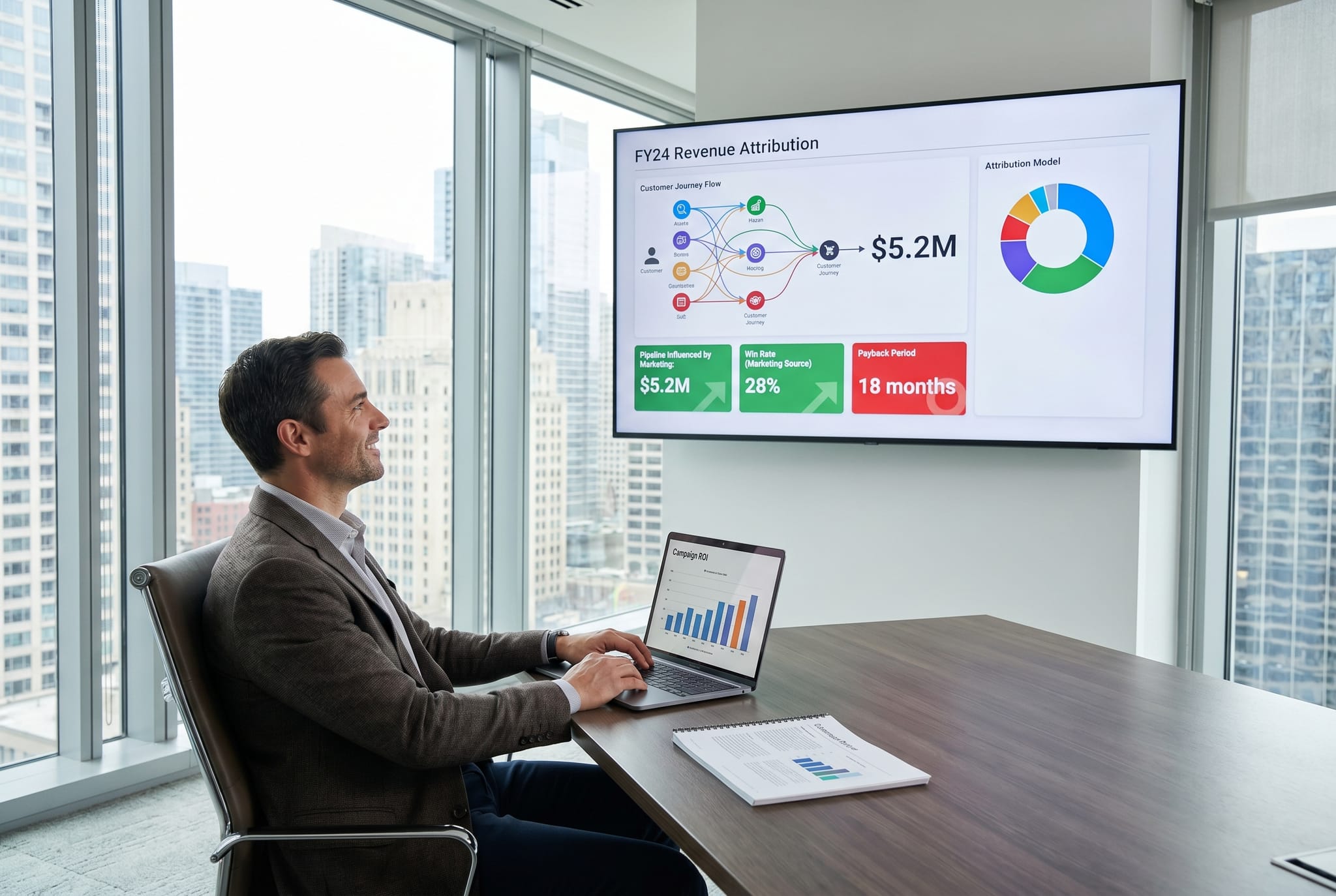
You can’t measure ABM the same way you measure demand gen. You’re not optimizing for cost per lead. You’re optimizing for deal size, win rate, and pipeline velocity.
Your metrics:
– Account engagement score (how active is the account in your ecosystem?)
– Time to first meeting (how fast are you getting in front of decision-makers?)
– Pipeline velocity (how fast are deals progressing?)
– Win rate (are you closing a higher percentage of opportunities?)
– Deal size (are you landing larger deals in ABM-targeted accounts?)
Most importantly: revenue. What’s the incremental revenue from ABM accounts versus non-ABM accounts? That’s your real number.
Here’s the brutal truth: ABM programs take 6-12 months to show real ROI. If your organization needs quarterly wins, ABM isn’t for you. But if you’re serious about enterprise growth, ABM works. I’ve seen it move the needle at scale.
The Bottom Line
ABM works because it mirrors how enterprise buying actually happens. It’s not one person deciding. It’s multiple stakeholders, multiple touchpoints, multiple conversations. When you align your marketing and sales strategy to that reality, deals close faster and you land bigger ones.
Start with account intelligence. Get that right. Everything else follows.