
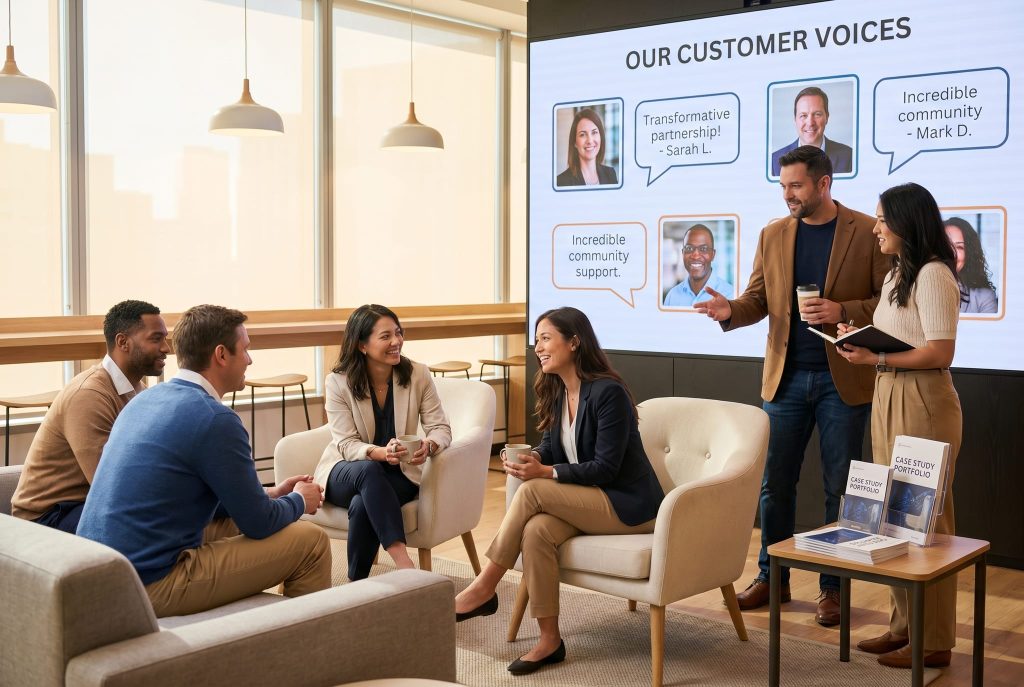
Your best salespeople aren’t on your team. They’re your customers.
And most companies never leverage them.
Your customers have solved the problems that your prospects are struggling with. Your customers use your product every day. Your customers can speak to the ROI in language prospects understand.
When your customer tells a prospect, “This tool changed how we operate,” that’s worth 10x more than any claim you make.
The question is: how do you systematically leverage your customer base as a growth channel?
Not with guilt trips. Not with “can you refer someone?” Not with hope that they’ll recommend you.
With a structured advocacy program.
I’ve seen advocacy programs generate 25-40% of new revenue. Not because they’re fancy. Because they’re structured.
Strategy 1: Build a Reference Account Program
A reference account is a customer who’s willing to be referenced.
Your sales team is in a deal. The prospect says, “That sounds great, but I need to talk to someone who’s actually using it.”
You pull up your reference list. You match them: “I have a CFO at a similar-sized financial services firm who’d be happy to talk to you.” You make an intro. The call happens. The prospect hears from another customer. Deal progresses.
Here’s how to build it:
Step 1: Identify your best customers. Most engaged. Most successful. Most measurable ROI.
Step 2: Ask them to be a reference. “We’re getting a lot of inquiries from companies like yours. Would you be willing to talk to a prospect or two per quarter?” Most will say yes if asked directly.
Step 3: Create a reference profile. Company. Company size. Industry. Use case. Measurable results. The prospect you’ll want to reference.
Step 4: When sales needs a reference, they search your library. Match on industry, company size, use case. Reach out to the reference. Set up the call.
Step 5: After the call, follow up with the reference. Did it go well? Would they do it again? Thank them.
The key: respect their time. Reference accounts get asked to do calls. If you overwhelm them with requests, they’ll opt out.
Create a service level agreement: “We’ll ask you for 2-4 references per quarter. Maximum 30-minute calls. We’ll coordinate all outreach.”
Strategy 2: The Case Study Machine
A case study is a story. It’s “how customer X solved problem Y.”
Most companies write boring case studies: “Company X had problem Y. They bought our solution. Result: 30% improvement in Z metric.”
Good case studies tell a story: “Company X was losing $2M per year because of Y problem. Their team was burnt out. Here’s what they tried before buying. Here’s why our solution worked. Here’s the journey from implementation to results.”
The best part: case studies aren’t just marketing. They’re proof.
How to build them:
Find your best customers with quantifiable results. Not just happy customers. Customers with measurable impact.
Interview them. Record the conversation. Ask: What problem were you trying to solve? Why was it important? What did you try before buying from us? Why didn’t it work? What made you choose us? What was the implementation like? What are the results? What would you tell someone considering buying?
Write it down. Tell the story. Include the metrics.
Do 2-3 case studies per quarter. You’ll have 8-12 per year.
Use them everywhere: sales decks, website, email campaigns, ads.
Here’s the magic: case studies work for every stage. Awareness (prospect reads it, sees companies like them getting results). Consideration (prospect compares your solution to competitors using the case study). Decision (prospect needs final proof before signing).
Strategy 3: Testimonial Vault
A testimonial is a quote from a customer.
Not the boring kind: “Great product, great team.” The useful kind: specific, quantifiable, relatable.
Bad testimonial: “We love using [product name]. It’s made our team more efficient.”
Good testimonial: “We reduced the time our reps spend on admin work from 4 hours per week to 30 minutes. That’s 70+ hours per rep per quarter we reclaimed for actual selling. [Product name] paid for itself in the first month.”
How to collect them:
Reach out to happy customers. “We’re building out customer testimonials on our website. Would you be willing to give us a quote?” Most will say yes if you ask.
Ask for specificity: “Tell me: what problem were you solving? What metric improved? What’s the impact?”
Use testimonials everywhere: homepage, landing pages, ads, sales decks, emails.
Rotate them by use case. If you’re selling to finance teams, highlight testimonials from finance leaders. If you’re selling to sales teams, highlight sales leadership testimonials.
Strategy 4: Build a Customer Advocacy Community
A customer advocacy community is where your advocates hang out, connect, and help each other.
This could be a private Slack. A private LinkedIn group. An exclusive community platform. A quarterly user group meeting.
The idea: your customers meet each other. They share best practices. They ask each other questions. They form relationships. And when you introduce them to a prospect, they’re more likely to engage because they’re part of a community.
Benefits:
For customers: access to other users, best practices, early access to features, recognition.
For your company: deeper relationships, better product feedback, advocates who feel like insiders.
For prospects: they see your customers talking about your product organically. That’s credible.
How to build:
Start small. If you have 50+ customers, you have enough to launch.
Pick a platform. Slack is easy. Circle is built for communities. LinkedIn group for simplicity.
Create channels for: product questions, best practices, feature requests, wins and success stories.
Invite your customers. Offer a reason to join: “Get help from other users. Share best practices. Access early features.”
Moderate it. Don’t let it become a complaint forum. Lead discussions. Highlight great posts.
Incentivize top participants. Recognize them. Give them special access. Make them community leaders.
The Incentive Question
Should you pay customers to be advocates?
In my experience: rarely. Most of your best customers want to help. They’re proud of what they’ve accomplished. They like being recognized. They want to connect with peers.
Where incentives make sense: formal referral programs. If a customer refers a customer who becomes a customer, you pay a referral fee (5-10% of first-year ACV or a flat fee).
But that’s transactional. The real magic is in the structural programs (reference accounts, case studies, communities) where the incentive is recognition and access, not money.
Measurement
Track:
Reference call conversion: What percentage of deals with a reference call close vs. without?
Case study impact: Which case studies drive the most traffic? Which industries resonate?
Community engagement: How many members? How many posts? How many prospects come through community connections?
Referral revenue: How much revenue comes from referred customers? What’s the LTV vs. non-referred customers?
The Payoff
Companies with structured advocacy programs:
Generate 3x more qualified leads from advocates than from marketing alone.
Have higher win rates because social proof is powerful.
Land larger deals because references come from customers in similar situations.
See lower CAC for customer-led deals because they’re warm introductions.
Have higher customer lifetime value because referred customers are more satisfied.
Start with reference accounts. That’s the easiest program to launch. Then add case studies. Then testimonials. Then build a community.
You’re building a growth engine powered by your customers.